Episode 10 — The Particle Becomes a Number
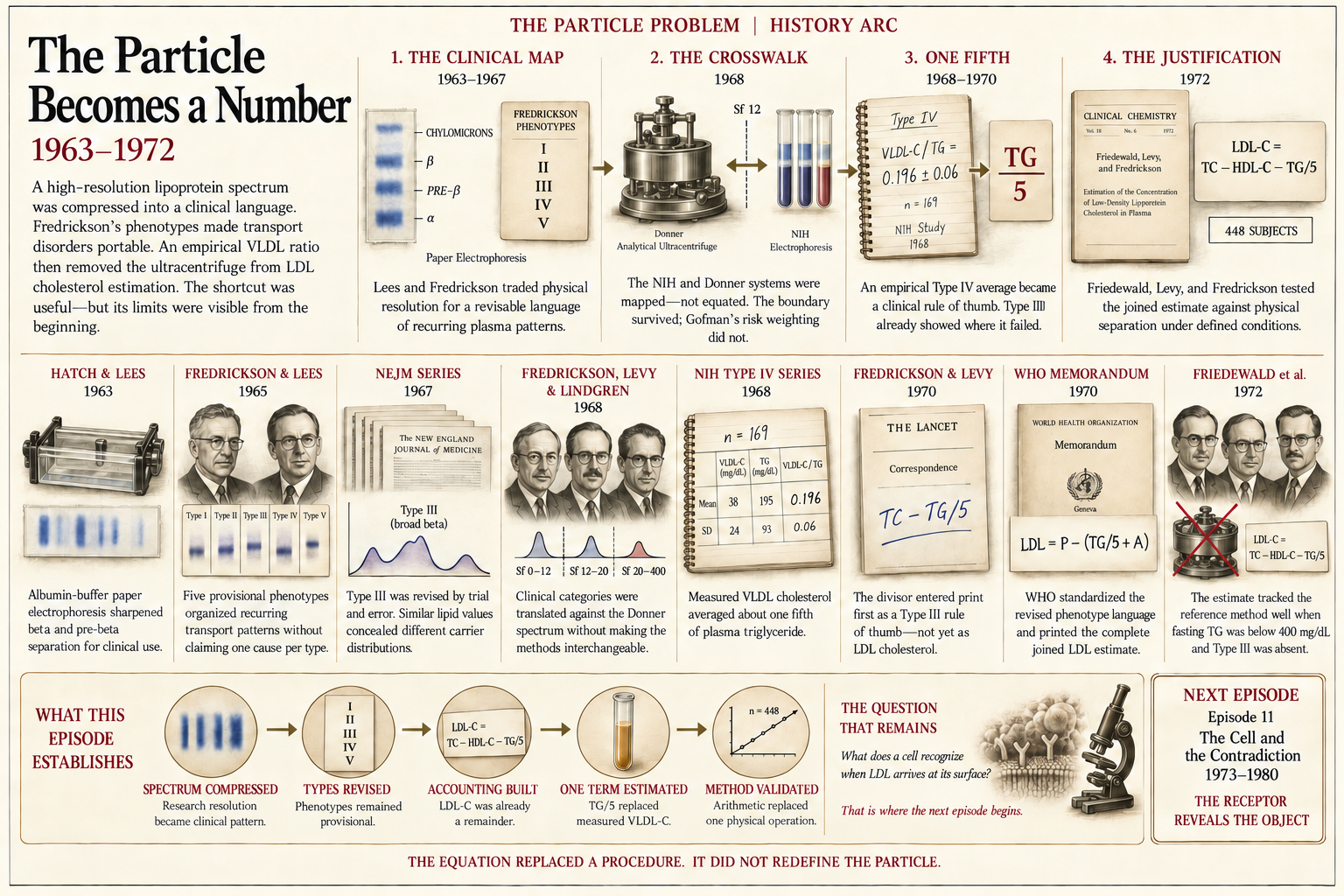
In June 1972, William Friedewald, Robert Levy, and Donald Fredrickson published four pages in Clinical Chemistry under a title that said exactly what it did: estimating the concentration of low-density lipoprotein cholesterol in plasma without use of the preparative ultracentrifuge. The familiar story begins there, a complicated physical measurement becomes an equation. But the paper describes its own purpose as justifying the method, not proposing it, and the record bears that out. In 1970, a World Health Organization memorandum on hyperlipoproteinemia had already printed the joined estimate, plasma cholesterol minus alpha cholesterol minus triglycerides divided by five, along with both restrictions that later became inseparable from it: not above 400 milligrams per deciliter of triglyceride, and not in Type III. The divisor itself runs back further. In January 1970 Fredrickson and Levy published TG over five in The Lancet as a diagnostic rule of thumb, and by July 1968 their laboratory had measured the relationship that made it plausible, among 169 patients with Type IV, a mean VLDL cholesterol to triglyceride ratio of 0.196, standard deviation 0.06. The reciprocal is about 5.10.
Episode 10 reconstructs the decade of clinical compression that produced that number. Lees and Hatch modified paper electrophoresis in 1963 to sharpen the beta and pre-beta separation, deliberately coarser than the analytical ultracentrifuge, which was the point. Fredrickson and Lees then built five phenotypes on four broad lipoprotein groups and said plainly that the numbering was arbitrary and the map revisable. It revised itself almost immediately: Type III began as a mixed beta-plus-pre-beta pattern and by 1967 had become the distinctive broad-beta phenotype, with the old mixed pattern later rehoused as Type IIb. A 1968 crosswalk written with Frank Lindgren, from Gofman's own laboratory, mapped the NIH categories onto the Donner flotation intervals while refusing to call them identical — and Gofman's differential weighting across those intervals did not carry forward into the clinical system. That same paper contains the subtraction architecture the equation would later inherit: LDL cholesterol was already a remainder, obtained after physically spinning the sample. What made the arithmetic urgent was throughput. One ultracentrifuge could process eighteen samples a day, and the program needed thousands. So one physically measured term was replaced by an estimate, and the failure mode was known before the substitution was validated, Quarfordt's 1971 work showed Type III beta-VLDL carrying triglyceride and cholesterol at roughly 1.2 to 1, nowhere near five. The 1972 validation tested 448 subjects, with Types I, III, and V excluded. Within that domain the agreement was excellent. What the paper established was never that a particle equals its cholesterol; it was that, under stated conditions, a physical separation could be approximated well enough to travel.