Episode 4 — The Problem That Changed Hands
By 1909, Alexander Ignatowski had left the Imperial Military Medical Academy for a professorship in Odessa, where he continued the egg-feeding work and sent preparations from one of the later rabbits back to St. Petersburg. We know this only because the investigators who received them said so, in a sentence buried near the end of someone else's paper. That November, Ignatowski published his expanded report in Virchow's Archiv, and it carried the finding past the gross abnormality of Rabbit Number Six: under the microscope, the primary changes lay chiefly in the intima — the inner layer, the one human atheroma actually occupies, and the layer the adrenaline model had never managed to reach. The title, however, still named the old theory: on the effect of animal protein on the aorta and the parenchymatous organs of rabbits. The lesion had become anatomically precise while the diet remained chemically entangled. And on the page before his conclusions, Ignatowski set his own limit on the result. The experiments, he wrote, could hardly be transferred to humans.
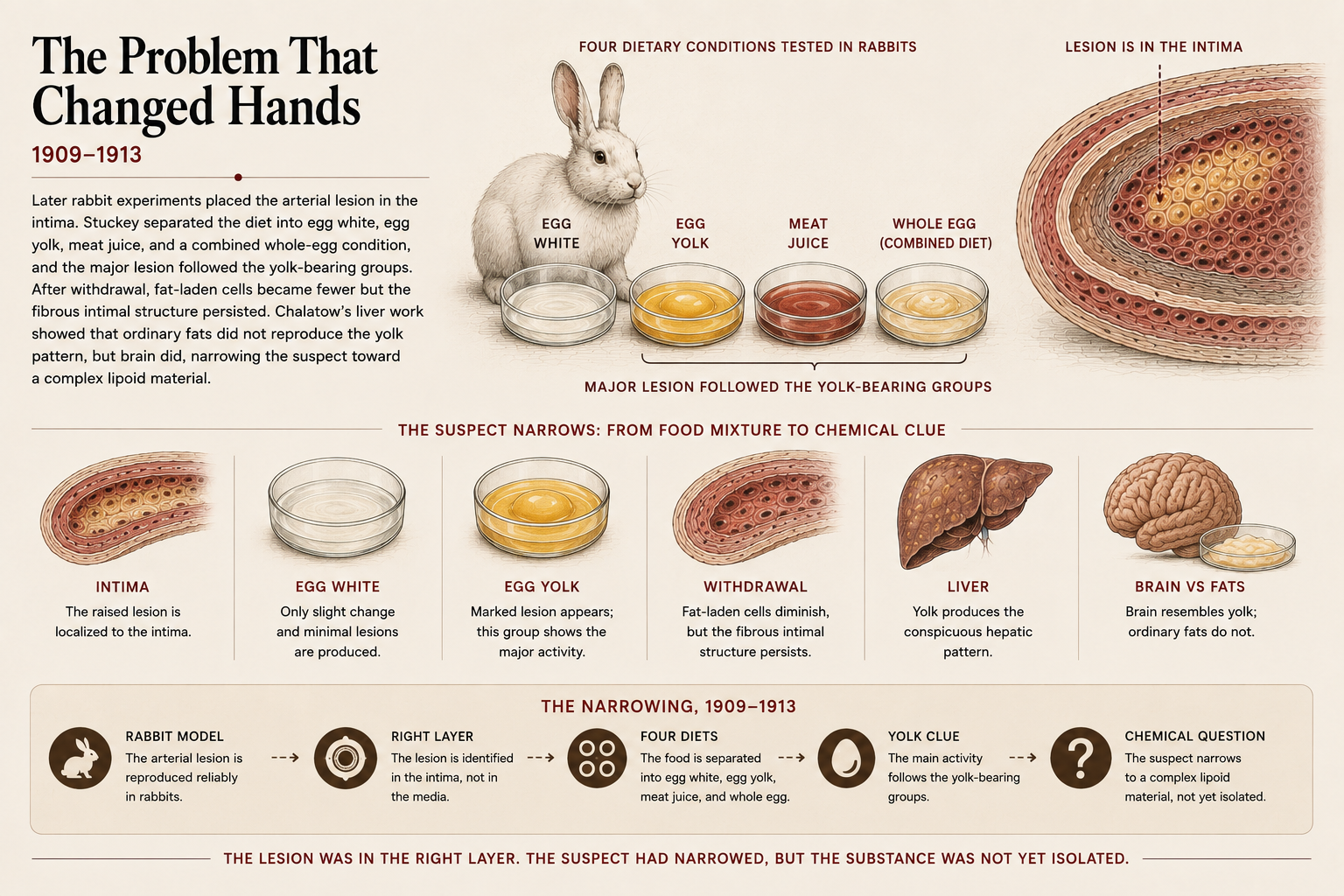
Episode 4 follows what happened when the problem passed from hand to hand — Ignatowski to Starokadomsky and Ssobolew, to Stuckey, to Chalatow — and each transfer made the question smaller and harder. Starokadomsky and Ssobolew built a raised, fat-laden intimal plaque they judged close enough to human atherosclerosis to deserve the name, though their design could not show that the hemodynamic preparation they credited was needed at all. Stuckey separated the bundle into four parallel feeding series: milk with egg white, milk with egg yolk, milk with meat juice, and all of it together. Egg white and meat juice produced only slight change. The two yolk-bearing bowls produced the disease. Animals returned to plant food afterward lost the conspicuous fat-filled cells but kept the thickened, fibrous wall. Then the livers from those same rabbits were handed to Semyon Chalatow, who found in the yolk-fed animals needle-shaped crystals that refused the fat stains and glowed under polarized light — and found them again when ox brain was fed in place of yolk, while sunflower oil, cod-liver oil, and tallow produced nothing comparable. The suspect had narrowed from animal food, to yolk, to something yolk and brain had in common. To go further, it would have to be separated out and fed alone.