Episode 8 — The Missing Middle
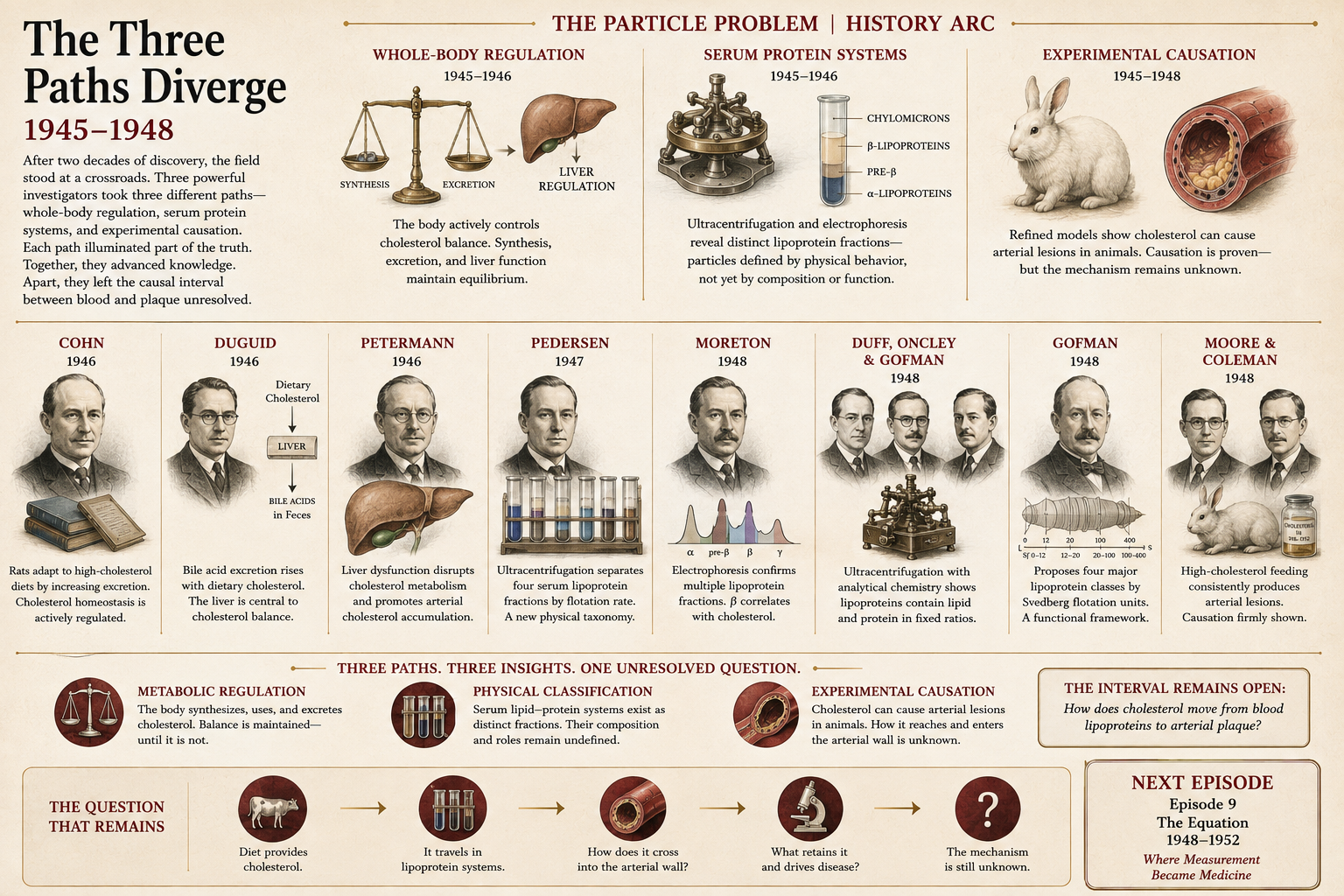
In 1949, G. Lyman Duff and George McMillan reported rabbits whose blood contained everything the cholesterol-fed model was supposed to require. The animals had been fed cholesterol for weeks; those made persistently diabetic with alloxan often had serum so lipemic it looked milky. One of them carried an average serum cholesterol of 401 milligrams per deciliter and the maximum lipemia grade, and its aorta showed no atherosclerosis at all. A matched control averaged 425, looked less cloudy, and developed severe disease. Across the series, the diabetic rabbits could sustain cholesterol concentrations equal to or greater than the controls' while developing markedly less arterial disease, and many developed none. Duff and McMillan concluded that a markedly raised blood cholesterol, sustained over time, was not by itself capable of producing arterial lesions. The result also undercut the newer explanation on offer — John Moreton's proposal that coarse lipid particles were the decisive condition — because these protected animals had exactly the visibly particle-laden serum the theory called for. Something between the number in the blood and the material in the wall was doing the deciding, and nobody could name it.
Episode 8 covers the five years in which that interval stopped being empty. Edwin Cohn learned to divide plasma into preparative fractions by the liter, showing cholesterol distributed across more than one protein-associated domain. Mary Petermann destroyed McFarlane's X boundary with a lecithinase preparation, establishing that the phospholipid was structurally necessary to whatever the instrument was seeing. Kai Pedersen assembled low density, beta mobility, lipid dependence, and flotation into a provisional identity, while insisting on the word labile. John Oncley concentrated most of the cholesterol from Cohn's beta-rich fraction into a smaller, still heterogeneous preparation. Meanwhile J. B. Duguid was arguing from the other end that some plaques were organized thrombi — blood incorporated into the wall and covered by new endothelium until it no longer looked like a surface deposit at all. Then John Gofman's group at Berkeley showed that much of the apparent instability of X had belonged to the measuring method, raised the density of serum so the low-density material floated free of the albumin boundary, and began dividing the domain into flotation classes. Among 104 patients with documented myocardial infarction, 101 carried measurable Sf 10–20 material. And the finding that mattered most for everything after: some people with total cholesterol between 120 and 140 carried appreciable amounts of it, while some above 200 had none the method could detect. At the same total, one person's cholesterol was arranged one way and another person's quite differently.