Episode 11 — The Cell and the Contradiction
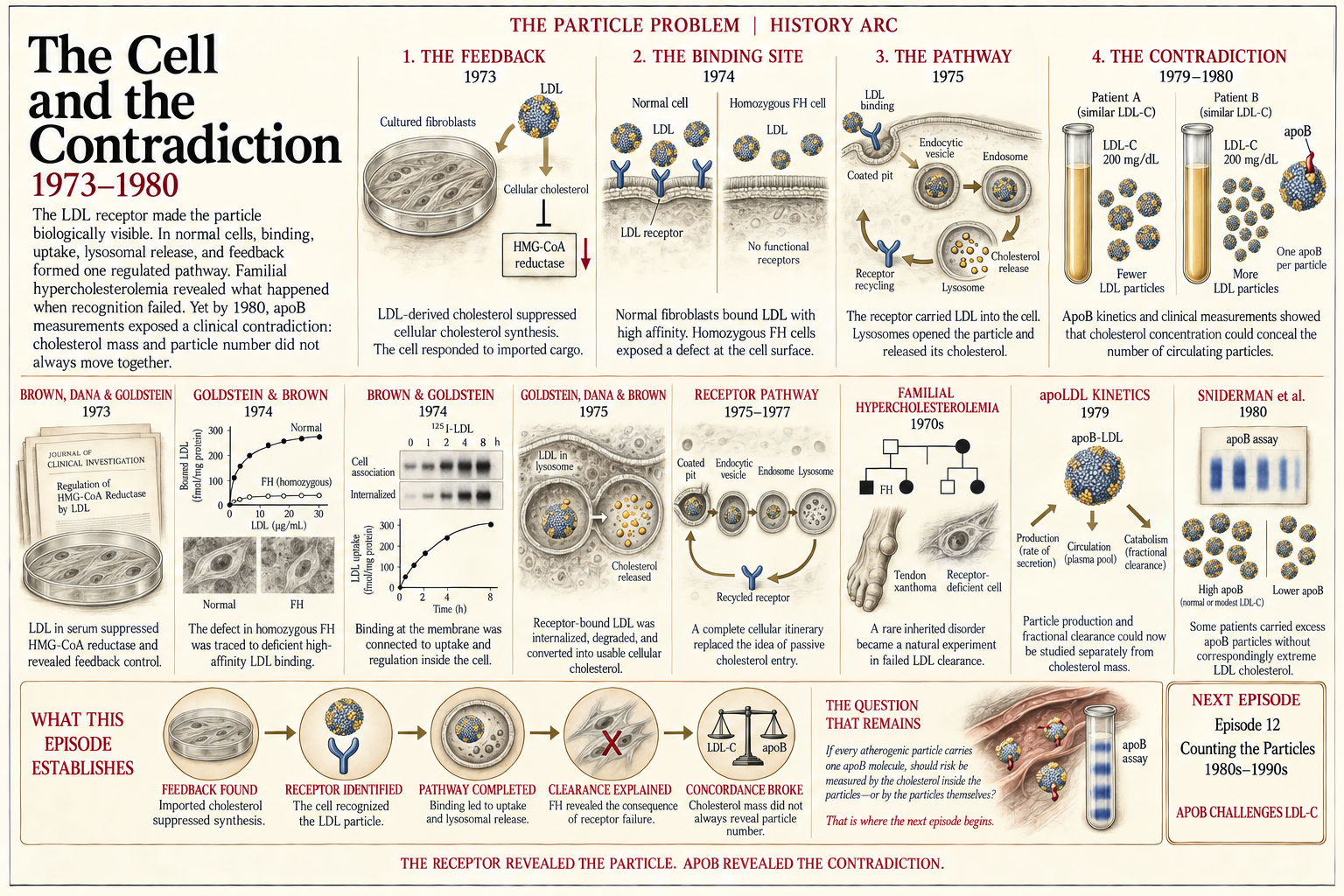
In January 1980, a Montreal laboratory reported one hundred consecutive patients sent for coronary angiography. In a substantial group with angiographically demonstrated disease, the cholesterol in their LDL looked ordinary while the protein holding the particles together was high. The measurement medicine had spent two decades building could not see them.
This episode reconstructs the seven years that made that finding intelligible. In Dallas, Michael Brown and Joseph Goldstein cultured skin cells from a twelve-year-old girl whose plasma cholesterol ran near a thousand milligrams per deciliter, and found a cell that would not stop manufacturing cholesterol no matter how much LDL surrounded it. The defect was not in the enzyme. It was in the cell's ability to recognize the particle at its surface. Over the next two years they traced the whole pathway — binding, uptake, lysosomal dismantling — and showed that LDL's cholesterol became available to a cell only after the carrier itself was taken apart. David Bilheimer then carried the receptor into the bloodstream, measuring how quickly apoLDL entered and left the plasma of patients carrying one or two copies of the mutation, and found that the disease altered both sides of the balance.
By 1980, medicine held three descriptions of LDL: the cholesterol assigned to a density compartment, a receptor-recognized particle, and a kinetic pool governed by entry and exit. In familial hypercholesterolemia all three pointed the same direction, and their agreement made the clinical measurement look complete. Allan Sniderman's patients showed what happened when they did not.