Episode 5 — The Founding Experiment
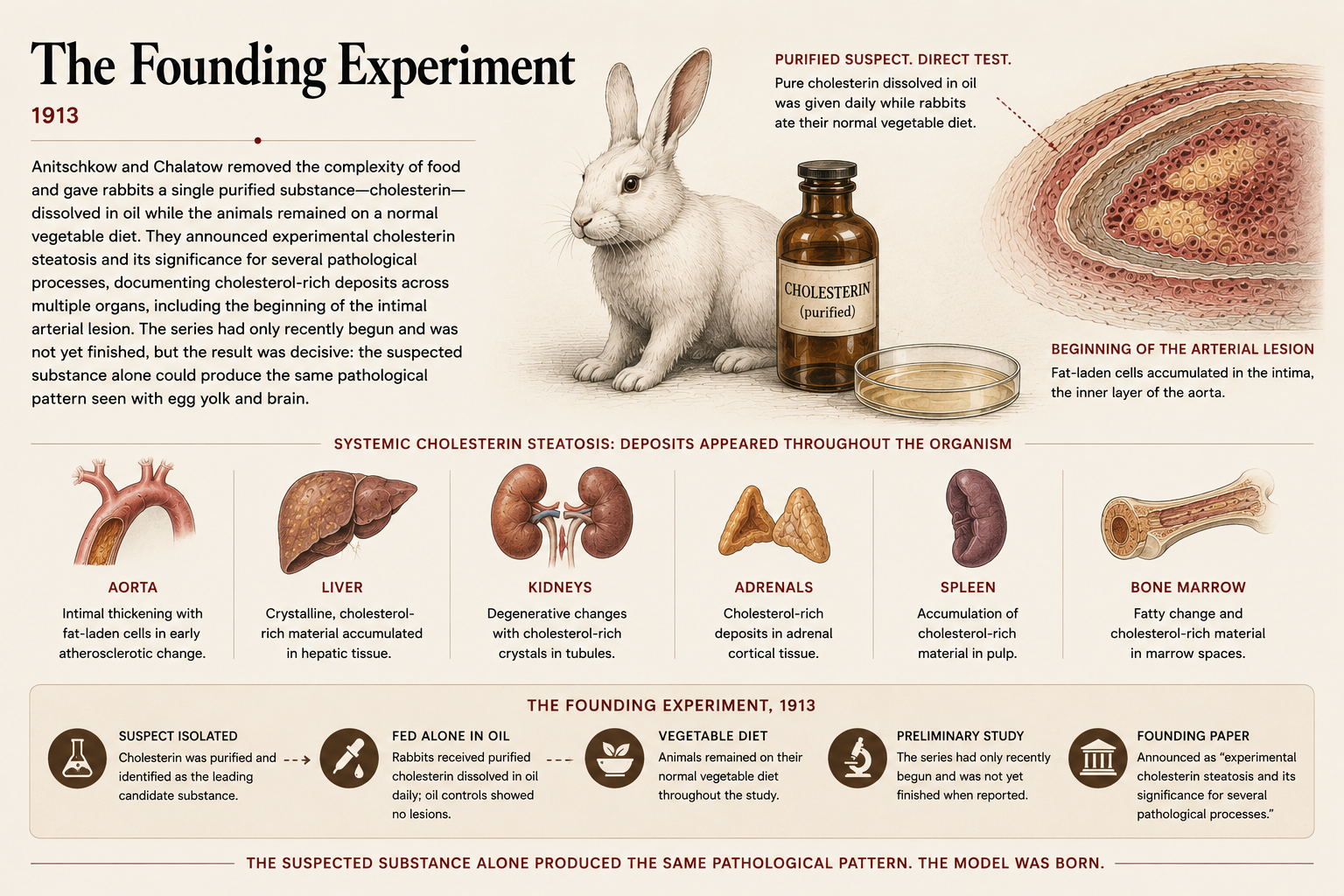
Episode 4 ended with a chemical question that no food could answer. Egg yolk and ox brain had each produced the characteristic lesion and the characteristic crystals, but each remained a mixture of neutral fats, phospholipids, sterols, proteins, and fatty acids, and the stains of the period could not settle which component had done the work. So Nikolai Anitschkow and Semyon Chalatow removed the food. In its place they gave rabbits a single purified substance dissolved in oil, while the animals went on eating their ordinary vegetable diet, and they gave control animals the oil without it. The substance was cholesterin, the term their paper uses for what we call cholesterol. Their report appeared in 1913 in the opening pages of volume twenty-four of the Centralblatt für allgemeine Pathologie, and its title did not mention atherosclerosis at all. It announced experimental cholesterin steatosis and its significance in the origin of some pathological processes: a distributed accumulation across liver, spleen, adrenal cortex, bone marrow, and aortic wall, of which the artery was one consequential site rather than the whole finding.
Episode 5 examines what that paper actually established, and what it did not. The study was unfinished when it was published, the authors say so, report no rabbit count, identify the vehicle only as oil, and give a daily amount with no unit attached. The aortic result at four to eight weeks is the beginning of the earlier intimal process, not the mature arterial morphology that made the cholesterol-fed rabbit canonical. White rats fed egg yolk in milk showed none of it, and the authors admitted the reason was completely unclear. The human argument rests not on a further experiment but on a correspondence: cholesterin already found in diseased human tissue, Windaus on lipoid material in atherosclerotic aortas, Chauffard on gallstones and altered cholesterin metabolism. What survives every one of those limits is a single comparison. Oil alone produced no essential organ changes; cholesterin in oil reproduced the liver crystals, the deposits across the other organs, and the intimal change in the aorta. A suspected constituent of two foods had become an experimental variable, and a defined substance could be measured, varied, withdrawn, and tested in other laboratories in a way a diet never could. The model had become portable. It had not yet become a theory of human disease.