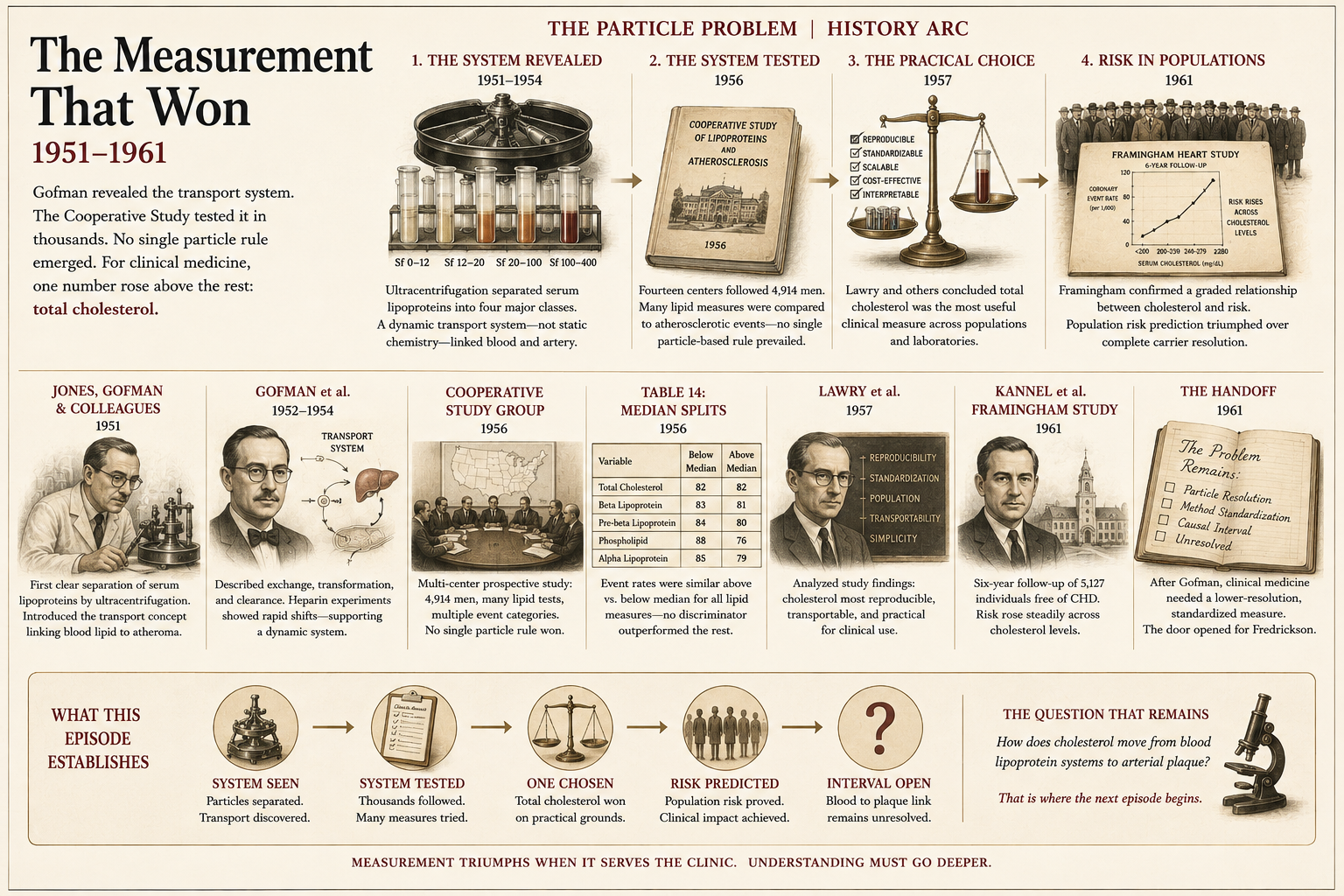
Episode 9 — The Measurement That Won
In October 1956, Circulation gave more than forty pages to a cooperative study of serum lipoproteins, cholesterol, and the later development of clinical atherosclerotic disease. Four laboratories had followed thousands of men judged free of cardiovascular disease at entry, to answer a direct question: could a physically resolved lipoprotein measurement identify later coronary disease better than total cholesterol could? The report did not end with one interpretation. The investigators had agreed on the study plan, the measurements, and the review of clinical events, and they did not agree on what the completed experiment had shown, so the committee published two discussions. Discussion A was John Gofman's Donner Laboratory. Discussion B was Cleveland, Harvard, and Pittsburgh, with the study's statistical and administrative leadership. The trouble reached back to 1950, when the program had been organized around a single flotation interval, Sf 12–20. Between 1951 and 1954, Donner's understanding of what the flotation classes represented had changed several times over, and the measurement Gofman now considered correct was not the one the trial had been built to test.
Episode 9 reconstructs what happened to the model while the study was running. Gofman's group turned a set of disease-associated fractions into an ordered pattern, then into a proposed metabolic chain, then into a compositionally graded transport system in which cholesterol ester dominated the denser end and triglyceride the buoyant end, meaning that neither chemical total could specify the distribution that produced it. Heparin experiments showed isolated high-flotation material converting into low-flotation material in vitro, making interconversion an observed phenomenon rather than a diagram. A weighted index followed, and then a cumulative-exposure model that separated a person's current rate from the burden already accumulated across a lifetime. By 1956 the prospective study was adjudicating a hypothesis that had grown into something much larger than the fraction named in its protocol, and the two sides were no longer comparing the same measurement against the same endpoint. What survived both discussions was that elevated blood lipids preceded the clinical event. What did not survive was any agreed rule for turning the lipoprotein spectrum into an individual prediction. Eleanor Lawry then showed how unstable an optimized cut point or index becomes when carried to a new population, and by 1961 Framingham had demonstrated what a cheap, reproducible, scalable variable could do across thousands of people and six years of follow-up. Total cholesterol had not become a complete description of the biology. It had become a number that laboratories could agree on. That is the narrow sense in which it won.