Episode 7 — The Problem Divides
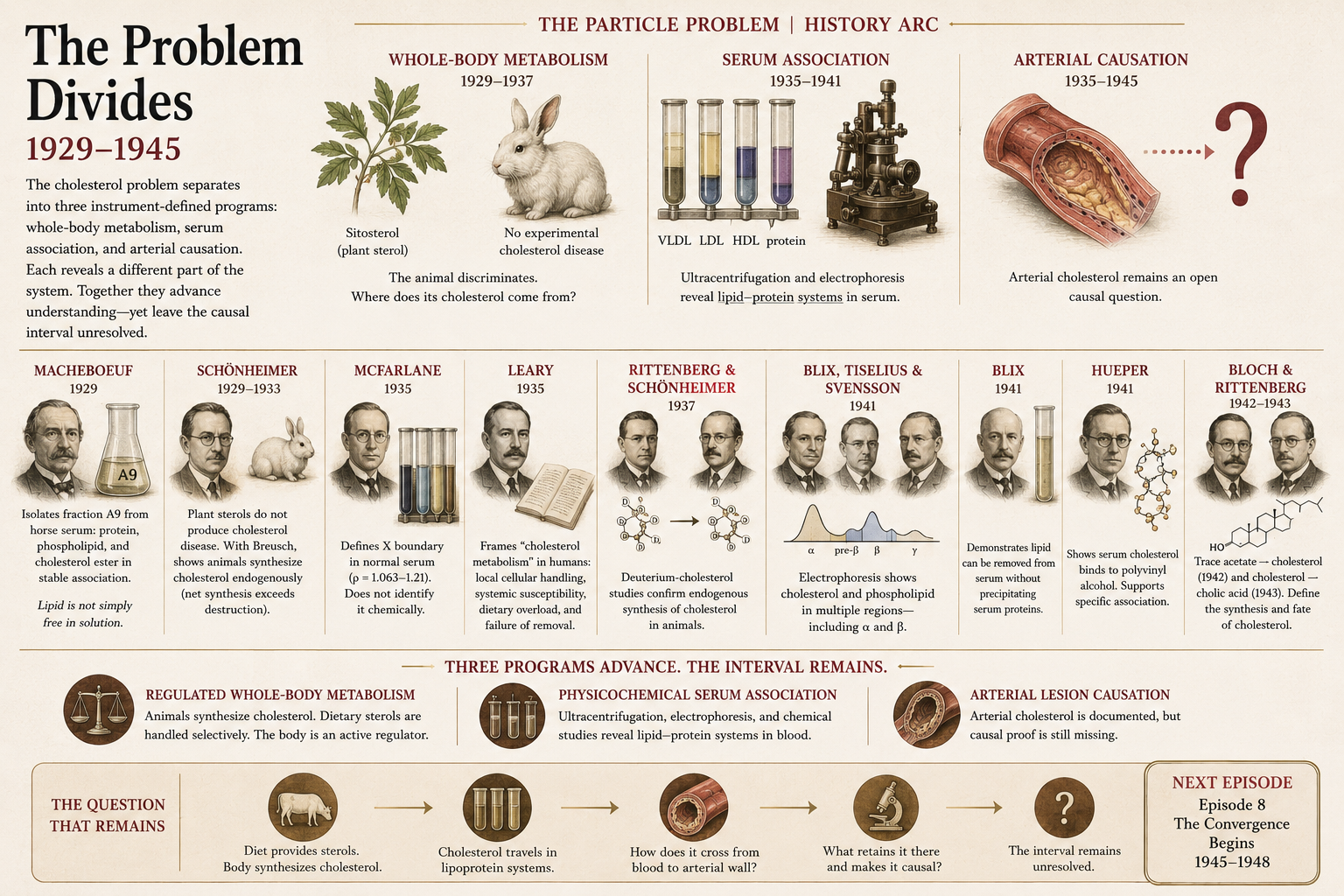
In 1929, two laboratories changed the cholesterol problem in different directions. At the Institut Pasteur, Michel Macheboeuf began with a physical difficulty: cholesterol and phospholipid do not dissolve freely in water, yet serum is mostly water and stays clear while carrying both. Starting from four liters of horse serum, he precipitated, redissolved, and precipitated again until, at the ninth round, he had a reproducible fraction of protein, phospholipid, and cholesterol ester that formed a clear aqueous solution and would not give up its lipid to cold ether. He called it A9, and he was careful about what it was not — a preparation recovered under laboratory conditions is not necessarily one native object circulating in blood. That same year, in Aschoff's institute at Freiburg, Rudolf Schönheimer fed rabbits sitosterol, a plant sterol closely related to cholesterol. The cholesterol-fed controls developed the familiar experimental disease. The sitosterol-fed animals developed nothing. The organism was discriminating between chemically similar substances — and if a herbivore's plant sterols were poorly absorbed and did not simply become animal cholesterol, then the animal had to be building its cholesterol itself.
Episode 7 follows the three programs those experiments opened, and the fifteen years in which none of them met. In the metabolic line, Schönheimer and Fritz Breusch sealed mice in glass flasks and digested the animals along with the food, bedding, and excreta so that no tissue could hide a sterol; bread-fed mice made in a month roughly as much cholesterol as their bodies had contained at the start. Deuterium then made synthesis visible inside a living animal whose total cholesterol never changed, labeled acetate was traced into the ring and side chain, and cholesterol was followed onward into bile acid. In the carrier line, A. S. McFarlane found an intermediate boundary in the ultracentrifuge that fit no expected protein and named it X — an anomaly, not an identity; Blix, Tiselius, and Svensson later located serum lipid across broad electrophoretic regions. In the lesion line, Timothy Leary made atherosclerosis a disorder of cholesterol metabolism while meaning something quite different by the word, and Wilhelm Hueper produced foam-cellular intimal lesions in dogs using a synthetic polymer with no lipid and no hypercholesterolemia at all. The division was built into the instruments: each made one part of the system legible and left the rest outside its field of view. By 1945 the field could describe a dynamic cholesterol system without naming its vehicle, separate lipid-bearing serum objects without knowing which entered an artery, and narrate the lesion without measuring either.