Episode 3 — The Poison Within
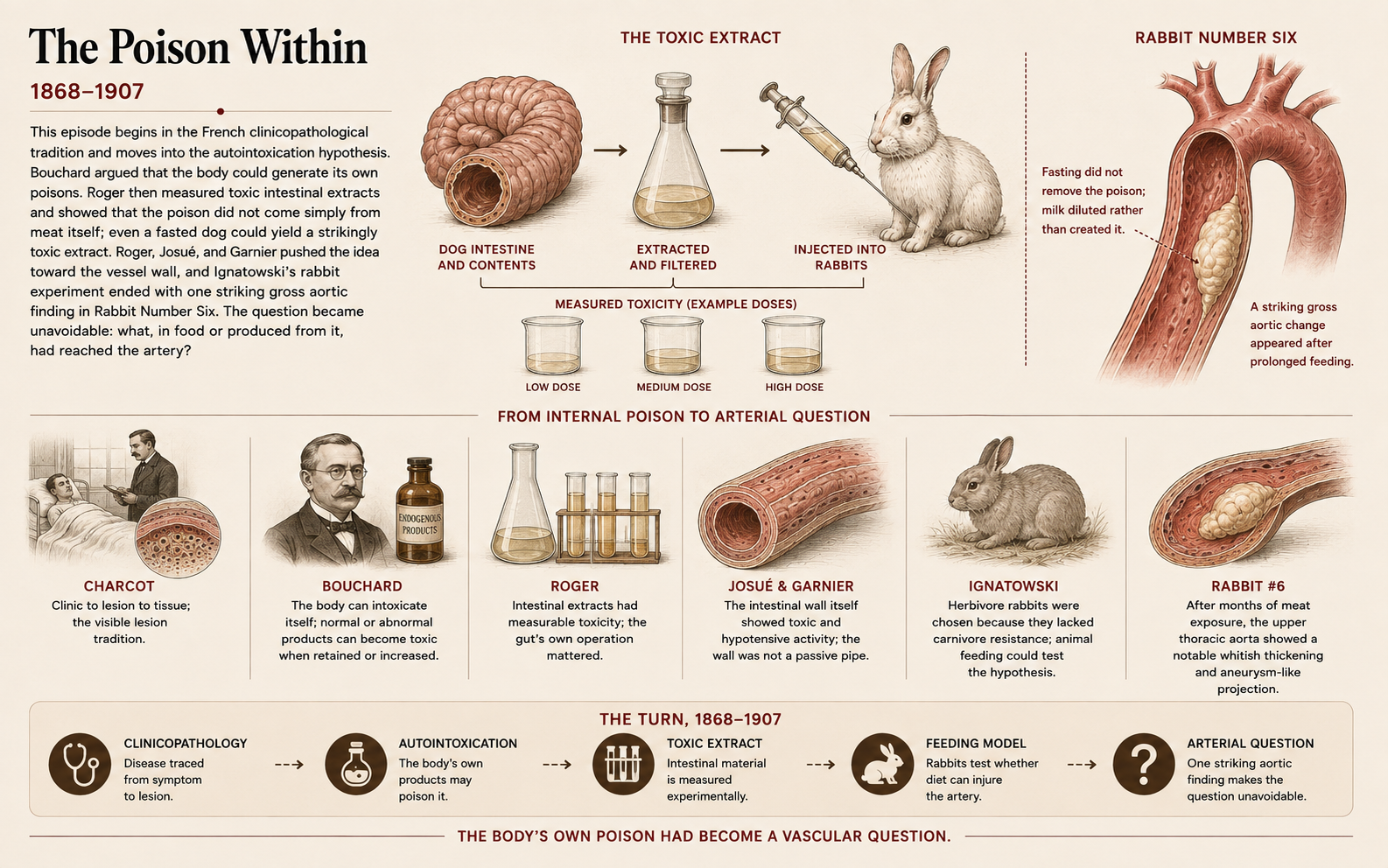
In experiments published in 1907, Georges-Henri Roger fed two dogs nothing but milk for three days, then opened the small intestine, pressed the contents through cloth, spun and filtered them, and measured how much of the clear liquid it took to kill a rabbit. Meat-fed dogs had yielded a far more toxic extract, exactly as the theory of intestinal putrefaction predicted. Then Roger examined a dog that had simply fasted for twenty-four hours, and found that its extract killed at a fraction of the volume. Milk had not created the poison; if anything it had diluted what was already there. The toxic material was coming from the intestine's own operation, though from exactly where, Roger could not yet say. That the body manufactures its own poisons, and that a disease may become visible far from where it begins, was Charles Bouchard's proposition, and it had been circulating in French medicine for two decades before anyone thought to point it at an artery.
Episode 3 follows the other French route to the artery, through primary sources, Charcot, Bouchard, Roger, Huchard, Metchnikoff, and Ignatowski. Where Josué had injected a defined poison directly into the circulation, this tradition started upstream, with ordinary food and ordinary digestion, and asked what an organism might produce from a diet it was never built to handle. Alexander Ignatowski put that question to a rabbit. Meat alone killed his animals within ten days; meat with carrots killed them within three weeks; only by raising the ration gradually, and cutting it back whenever the urine showed injury, could he keep an herbivore eating meat for months. He examined the animal he had numbered six after eight months, and found the upper thoracic aorta thickened and whitish near the origins of its branches, projecting outward at one site, no longer flexible. It proved nothing on its own. One striking gross finding in one animal could not name the responsible substance, establish its route, or rule out anything else. By May 17, 1907, the finding had entered the Petersburg scientific record, and the problem was about to change hands.