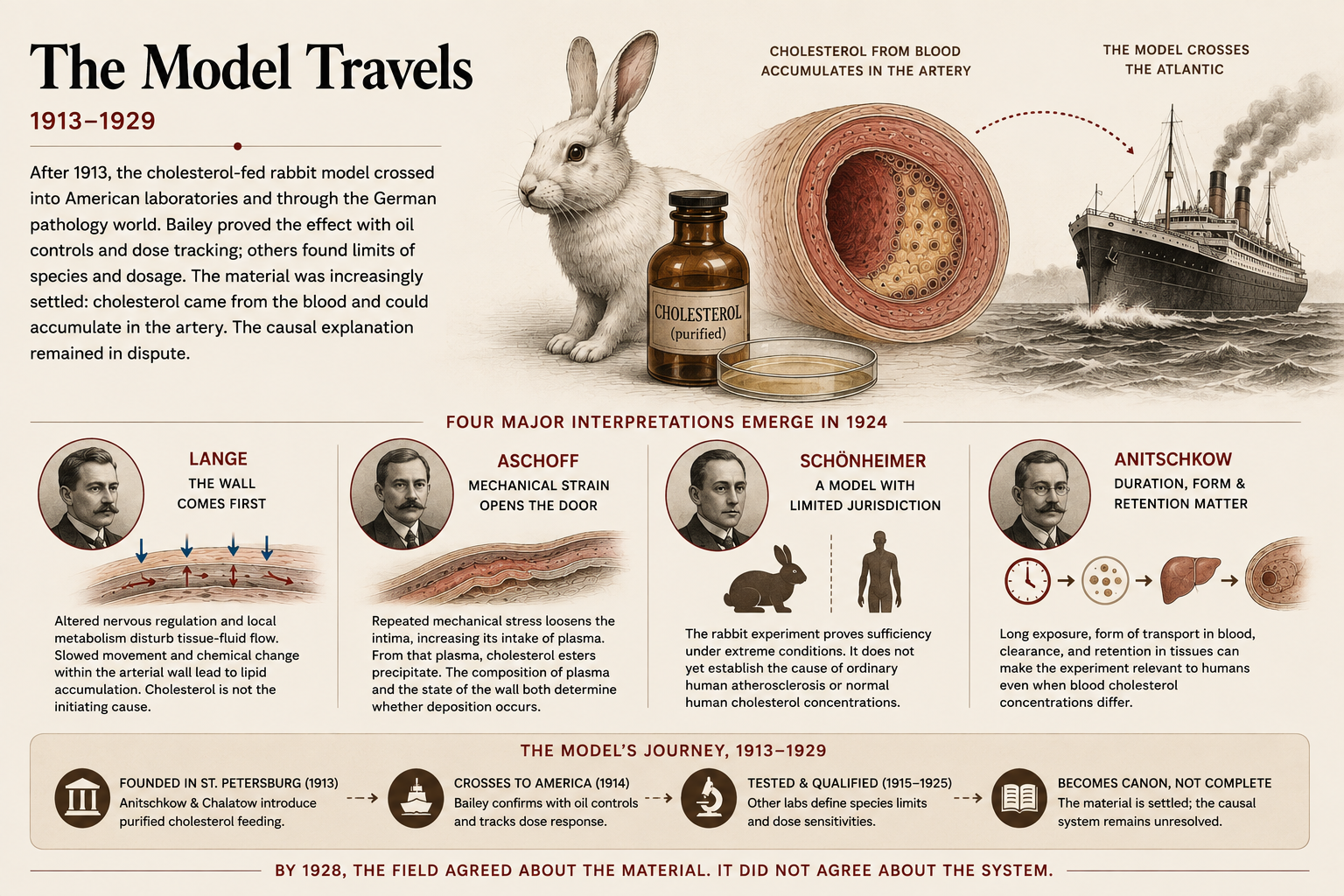
Episode 6 — The Model Travels
In December 1924, two papers appeared in the same issue of Virchows Archiv. The first, forty-two pages, came from Rudolf Schönheimer, a young pathologist and chemist in Ludwig Aschoff's institute at Freiburg, and was titled On the Experimental Cholesterol Disease of Rabbits. Ten pages later came Nikolai Anitschkow's On the Etiology of Atherosclerosis. Both began from the same evidence, and by then the evidence itself was no longer seriously disputed: feed cholesterol to rabbits, raise the cholesterol in their blood, and lipid-rich deposits appear throughout the animal, including in an arterial lesion that can closely resemble human atheroma. What remained in dispute was what the experiment licensed anyone to say. Schönheimer took the systemic character of the rabbit disease seriously, the animal had been driven into an extraordinary physiological state, not given an isolated disorder of the aorta, and declined to let experimental sufficiency become human etiology without an intervening argument. Anitschkow supplied that argument in the paper immediately following: a single blood measurement taken at one moment was the wrong comparison, because duration, prior exposure, unequal clearance, and the physical form in which cholesterol traveled could all separate what the artery had experienced from what the sample showed.
Episode 6 follows the cholesterol-fed rabbit out of St. Petersburg and into the laboratories, textbooks, and lecture halls that had to decide what it proved. At Stanford in 1915, C. H. Bailey ran fifteen rabbits against a vehicle control that received more cottonseed oil, over more days, than any cholesterol-fed animal, and found nothing; low cholesterol exposures produced nothing either; sustained higher exposure produced the disease. The same paper made the model harder to translate, because Bailey's rabbits accumulated lipid in the pulmonary artery, liver, spleen, kidneys, adrenals, and marrow as well. Then came 1924, which produced four interpretations rather than two camps: Fritz Lange, treating the arterial wall as a living transport compartment whose failure came first; Aschoff, beginning with mechanical loosening and insisting that deposition depended on the entire physicochemical structure of the plasma; and the two December papers. Zinserling's Sudan stain then found intimal lipid in 95.5 percent of 302 childhood aortas, moving the apparent beginning of the disease backward through childhood without establishing that every early deposit became a plaque. Fischer-Wasels and Jaffé assembled the pieces into an exposure–transport–retention system and stated plainly that what mattered was the colloidal state in which cholesterol existed, not how much of it was present, the carrier problem, visible in 1927 as a missing mechanism. Heinrich Beitzke refused the settlement entirely and put focal injury beneath the intima first. By 1928 the field largely agreed about the material and not at all about the system. Answering that would require knowing what, exactly, was carrying the cholesterol.