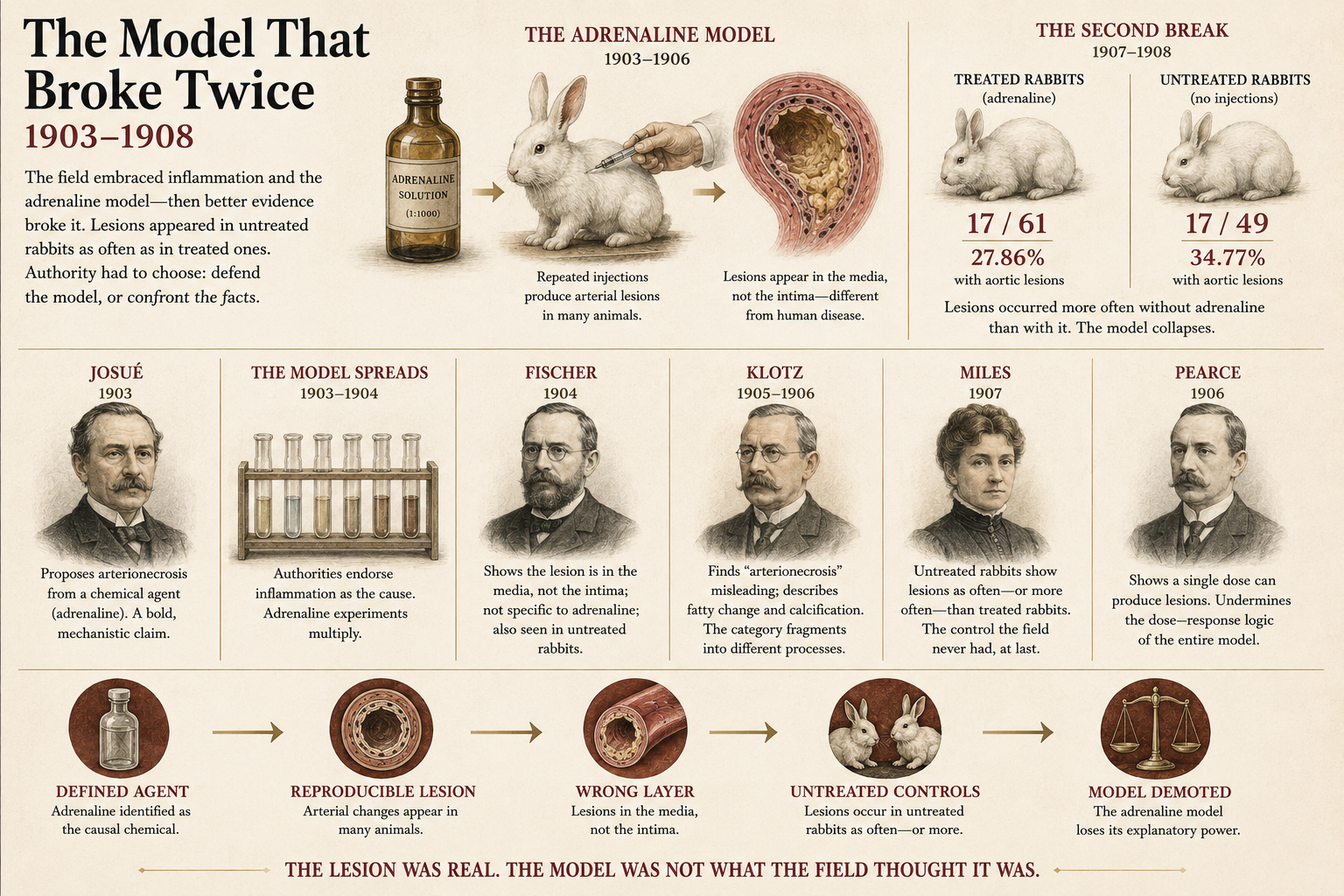
Episode 2 — The Model That Broke Twice
In November 1903, a Paris physician named Otto Josué presented a two-page communication to the Société de Biologie. Rabbits given repeated injections of adrenaline into the ear vein developed calcified plaques on the aorta, with no prior mechanical injury to the vessel. Adrenaline was both a vascular poison and a pressor agent, so whichever of the two prevailing theories of atheroma proved correct, slow intoxication or sustained hypertension, the model should produce the lesion. It did. Within four years, laboratories in Paris, Lyon, Berlin, and Chicago had confirmed the finding, and adrenaline had become the dominant experimental route to arterial disease in the Western pathology literature. By 1907 the Journal of the American Medical Association could report that Josué's main contention had received complete confirmation, and then, in the same paragraph, list the reasons it should not be trusted.
Episode 2 traces how that model came apart, twice, in two different ways, through primary sources: Josué, Huchard, Fischer, Klotz, Pearce and Stanton, Thévenot, Miles, Johnstone, and Lange. Fischer, in 1905, found the lesion sitting in the media rather than the intima, reproduced it with other substances entirely, and found it in rabbits that had died of wasting illness without ever receiving an injection. Klotz argued that the term atheroma should be discarded. Then, in October 1907, Amy Miles counted rabbits that had received no adrenaline at all and found the lesion more often in them than in the treated animals. Richard Pearce answered her the following winter with his own census, admitted in print that he had withheld his 1905 controls because the sample was small, and closed the question by lowering what the model was permitted to claim. Nobody delivered a refutation. The model was demoted, one paper at a time.